Introduction
Industrial sites are becoming increasingly dynamic. People, vehicles, automation systems, and equipment now operate simultaneously within shared spaces, making safety more complex as movement, speed, and operational activity increase.
Risks are no longer caused only by single errors. They often emerge from repeated movement patterns, congestion, unsafe interactions, and operational behaviors that traditional monitoring systems may not capture in real time.
Many organizations still rely on surveillance systems and manual observation to assess safety. While these methods provide visibility, they often lack the contextual intelligence needed to understand how risk develops throughout the day.
Modern industrial operations require continuous safety awareness: the ability to sense movement behavior, understand operational patterns, and detect unsafe conditions before incidents occur.
This is where industrial motion analytics and AI-powered crowd analytics are reshaping workplace safety. By transforming live movement into operational intelligence, Vision AI helps facilities improve awareness, reduce exposure, and support safer decision-making in complex environments.
The Shift from Passive Monitoring to Intelligent Movement Awareness
Traditional industrial monitoring is mostly reactive. It captures events after they happen, allowing supervisors to review footage and investigate incidents. However, in fast-moving environments, this provides limited prevention value because the underlying risk may have existed for days or weeks before the incident occurred.
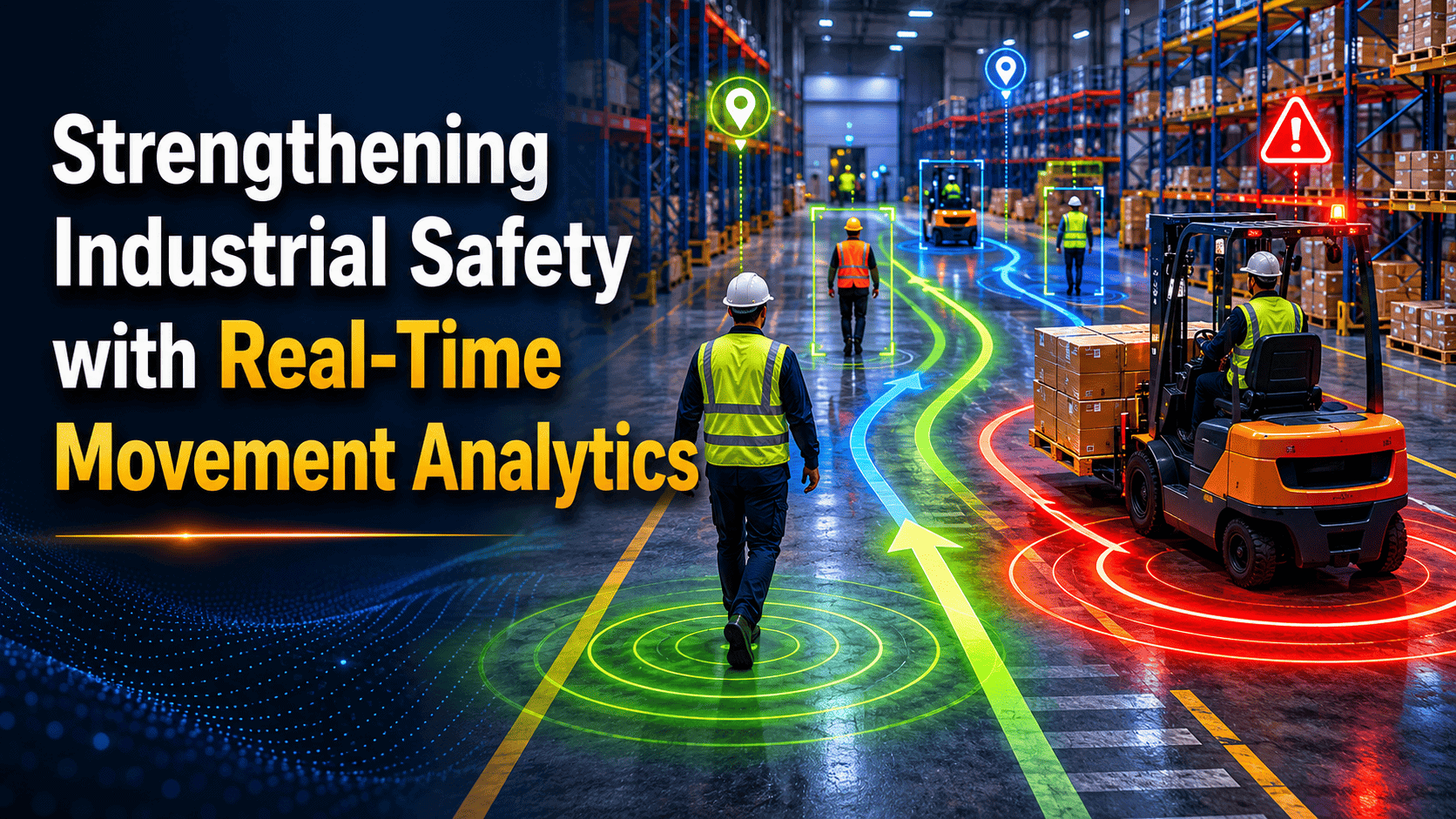
Today’s Vision AI solutions move beyond observation toward understanding. Industrial motion analytics enables continuous interpretation of interactions between workers, forklifts, autonomous vehicles, and equipment across operational zones.
This helps facilities identify:
- Repeated congestion patterns
- Unsafe crossing behavior
- High-risk intersections
- Abnormal movement trends
- Recurring near-miss exposure
How Industrial Motion Analytics Reveals Hidden Operational Risk
Movement inside industrial facilities follows patterns. Forklifts often repeat the same routes, workers move between stations throughout the day, and traffic levels change across shifts. Even small variations in these patterns can create meaningful safety exposure.
Industrial motion analytics uses Vision AI to generate insights from variables such as:
- Movement speed
- Directional flow
- Proximity between workers and vehicles
- Dwell time in shared areas
- Interaction frequency at intersections
When measured continuously, these variables reveal where pressure builds up, why certain zones become high-risk, and how operational design contributes to unsafe conditions.
AI-Powered Crowd Analytics for High-Density Industrial Zones
Crowd-related risk is not limited to public spaces or transportation hubs. In industrial environments, high-density activity can reduce both safety and efficiency.
Loading docks, transfer points, narrow aisles, and staging areas often experience temporary surges in activity. Without continuous visibility, congestion can build unnoticed and create risks for equipment movement, worker coordination, and safe operations.
AI-powered crowd analytics helps facilities monitor density and movement distribution across industrial areas in real time. Vision AI can identify where crowd pressure is increasing, how many people are present, and how movement flows through the facility.
This level of awareness supports:
- Better coordination between workers and vehicles
- Safer interaction between people and equipment
- Earlier identification of congestion buildup
- Improved traffic separation strategies
- Reduced operational peaks
- More effective management of high-density zones
Turning Motion Data into Predictive Operational Intelligence
The value of motion analytics lies in correlating speed, trajectory, proximity, and congestion frequency to identify elevated-risk conditions before incidents occur.
Modern Vision AI systems monitor real-time activity and detect patterns associated with higher risk. This allows organizations to address the conditions that often lead to safety events or operational disruption.
Predictive analytics can reveal:
- Zones with repeated near-miss occurrences
- Congestion trends linked to specific workflows
- Unsafe movement patterns during peak periods
- Traffic restrictions caused by facility layout
- Repeated pedestrian and vehicle interaction risks
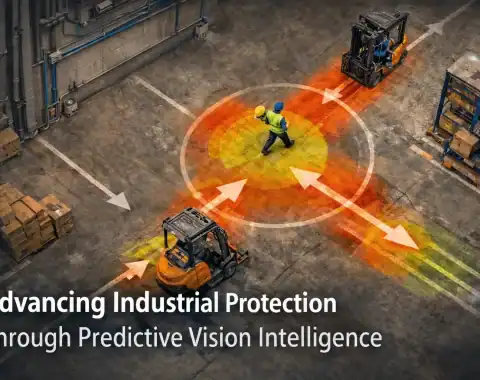
Using heatmaps, behavioral analytics, and live risk scoring, supervisors can prioritize interventions based on operational evidence rather than assumptions.
This helps companies improve safety in a targeted way without creating unnecessary disruption to the workforce.
Enhancing Workflow Efficiency with Spatial Analytics
Industrial safety and operational efficiency are closely connected. Poor traffic flow, inefficient layouts, and congestion can reduce productivity while increasing risk.
Spatial analytics helps facilities understand how space is actually used throughout the day. By analyzing movement distribution and interaction points, organizations can identify opportunities to improve both workflow and safety.
These insights support:
- Facility layout optimization
- Smarter routing strategies
- Improved pedestrian and vehicle separation
- Reduced cross-traffic in shared areas
- Better use of industrial space
Supporting Modern Industrial Automation Safely
Automation is increasingly being introduced into industrial facilities alongside traditional operations. Manual forklifts, autonomous mobile robots, semi-automated systems, and human workers often share the same environment.
This creates coordination challenges that conventional safety systems are not designed to manage effectively.
Industrial motion analytics provides a scalable safety layer for mixed operational environments. Instead of analyzing each device independently, Vision AI evaluates how all moving components interact within the same space.
This helps organizations:
- Maintain visibility across mixed fleets
- Identify unsafe interaction patterns early
- Improve synchronization between automated and manual systems
- Reduce operational blind spots
- Monitor exposure at scale without unnecessary alerts
The Long-Term Advantages of Smart Motion Analytics
The impact of AI-powered operational intelligence extends beyond incident prevention. Over time, continuous movement analytics can support broader improvements in safety, compliance, and performance.
Long-term benefits include:
- Improved compliance visibility
- Reduced operational downtime
- Better workforce awareness
- Evidence-based safety training
- Faster detection of recurring inefficiencies
- Better planning for facility expansion and automation
Final Thought
Industrial environments are becoming more connected, automated, and operationally complex. In these settings, safety cannot depend only on human observation or isolated monitoring systems.
Organizations need to understand how movement patterns evolve, where operational pressure builds, and how unsafe conditions develop over time.
Industrial motion analytics and AI-powered crowd analytics make this possible by converting real-time facility movement into actionable intelligence. By integrating Vision AI into daily operations, facilities can move from reactive safety management toward a more predictive, adaptive, and resilient model.
Learn how Cognistic’s Mantis IX transforms industrial motion analytics and AI-powered crowd analytics into predictive safety intelligence across complex industrial environments.
Frequently Asked Questions
- In what ways does industrial motion analytics enhance workplace safety?
Industrial motion analytics observes movement behavior to identify unsafe interactions, congestion buildup, and operational risks before they lead to incidents.
- What exactly is industrial AI-powered crowd analytics?
In shared industrial environments, AI-powered crowd analytics tracks density, occupancy, and movement patterns to improve safety, coordination, and operational efficiency.
- Are near-miss situations detectable through movement analytics?
Yes. Vision AI systems can detect unsafe proximity, repeated interaction risks, and congestion patterns that often contribute to near-miss incidents.
- Does Cognistic’s analytics platform require wearables or tracking devices?
No. Cognistic’s Vision AI solutions work with existing infrastructure and overhead monitoring without requiring wearable devices or physical tracking tags.
- Can industrial motion analytics support mixed automation environments?Yes. Industrial motion analytics helps organizations monitor interactions between workers, forklifts, and autonomous systems across shared operational environments.