Introduction
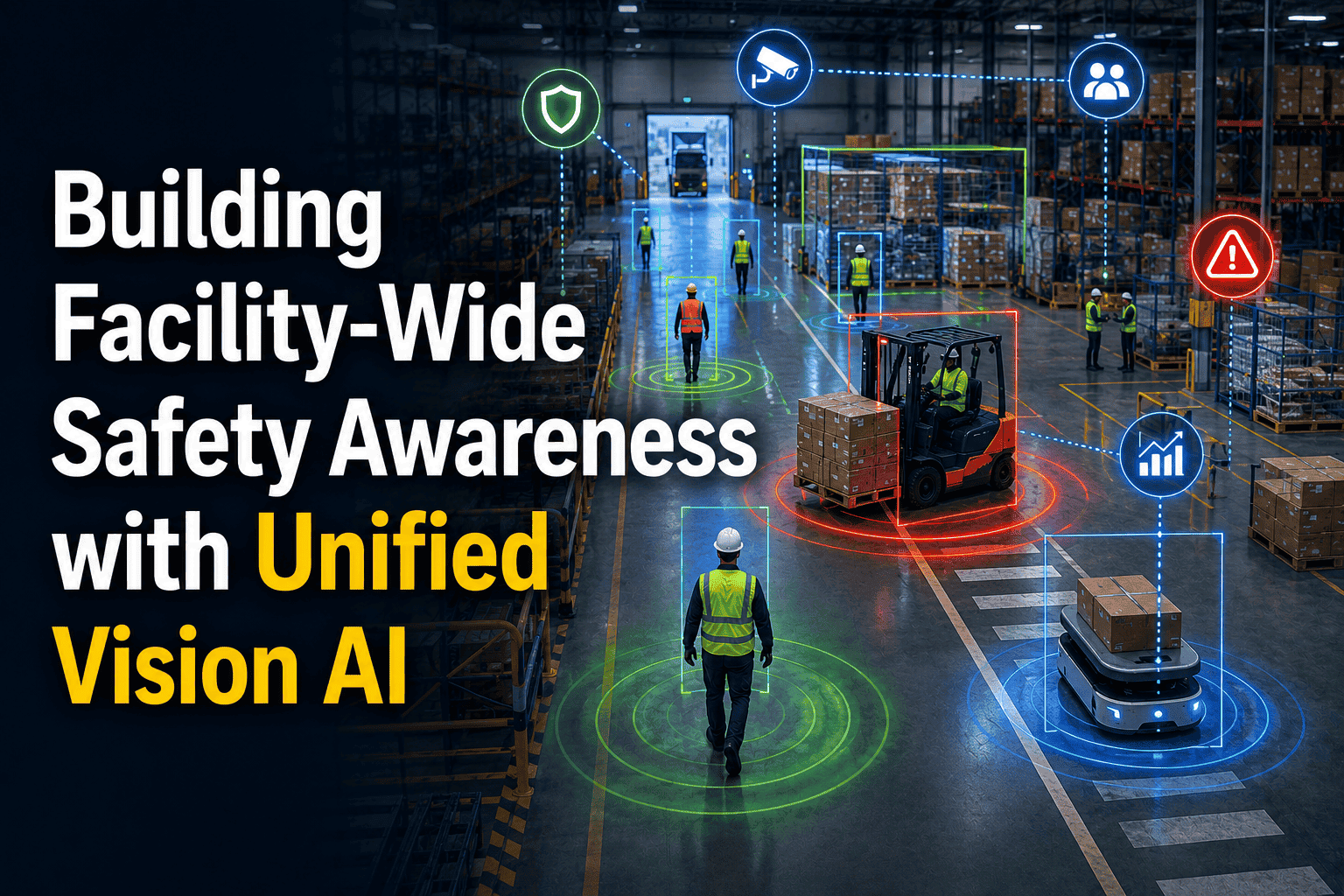
Industrial facilities are operating at higher speed, density, and complexity than ever before. Warehouses, manufacturing facilities, logistics centers, and distribution centers now manage a constant flow of people, forklifts, automated systems, and material handling equipment within shared operational areas.
In these environments, traditional safety systems often operate in disconnected layers, creating major blind spots. Supervisors may rely on separate monitoring tools, isolated alerts, and disconnected workflows, making it difficult to understand the real-time risk condition across an entire facility.
Organizations are increasingly adopting Mantis IX for overhead 3D Vision AI analytics, together with the iMANTRAX Solution for centralized safety monitoring and operational awareness. Together, these technologies provide real-time visibility across the industrial ecosystem, helping teams detect unsafe conditions sooner, respond faster, and strengthen operational resilience.
Preventing incidents is not only about reacting when something happens. Unified Vision AI intelligence helps facilities continuously understand operational behavior and respond proactively to changing risk.
This article explores how unified Vision AI can help industrial facilities move from fragmented monitoring to centralized safety intelligence.
Unified Visibility Is Essential for Industrial Safety
Many industrial facilities use several separate safety tools across different areas. One zone may rely on camera surveillance, another on an access control system, and another on a vehicle warning system. Each tool provides a degree of visibility, but none of them alone delivers a complete picture of operations.
This fragmentation can create several challenges:
- Limited understanding of hazardous situations
- Weak coordination between operational teams
- Different levels of visibility across sites
- Delayed response during high-activity periods
In dynamic industrial settings, risk is not always isolated to a single location. Traffic congestion in one area can affect another. A vehicle may be moving safely in one zone but still create exposure in a downstream zone because of connected workflows.
To address this challenge, the iMANTRAX Solution centralizes operational visibility, live alerts, and behavioral analytics into one safety intelligence platform. A single operational view gives supervisors facility-wide awareness and supports faster, more coordinated decisions.
Understanding the Role of 3D Vision AI Solutions
Traditional camera systems provide visibility, but they often lack accurate spatial understanding. Video footage may capture motion, but it does not always determine depth, movement paths, or changing interaction risks.
3D Vision AI solutions solve this problem by combining spatial perception with real-time analytics. These systems do more than record movement. They continuously assess how people, vehicles, objects, and equipment move in relation to each other within operational environments.
Depth-aware Vision AI can analyze:
- Distance between moving objects
- Relative speed and direction
- Interaction trajectories
- Dwell patterns in work areas
- Spatial congestion patterns
This added intelligence helps facilities detect unsafe conditions that standard monitoring may miss.
Real-Time Detection of Unsafe Operational Conditions
Industrial operating conditions can change rapidly throughout the day. Traffic volumes shift, work processes change, priorities move, and peak activity periods create new exposure. Without real-time intelligence, unsafe conditions may not be identified until a problem occurs.
With Mantis IX overhead 3D Vision AI analytics, facilities can continuously monitor movement behavior, spatial interaction, and operational risk in real time.
This includes detection of:
- Vehicles operating too close to pedestrian traffic
- Unauthorized entry into restricted areas
- Blockages in shared workspaces
- Abnormal movement behavior
- Unsafe traffic interactions during peak periods
Instead of relying only on manual supervision, Vision AI systems provide instant notifications when operating conditions exceed predefined safety limits.
This allows supervisors to intervene early by:
- Redirecting traffic flow
- Adjusting facility movement patterns
- Improving coordination between workers and vehicles
- Addressing congestion before it becomes critical
- Strengthening control across high-risk operational areas
Centralized Safety Monitoring for Industrial Facilities
As facilities grow, safe operations become harder to manage. Supervisors often oversee multiple zones at once, while visibility gaps across operational areas can delay response and reduce coordination.
The iMANTRAX Solution centralizes:
- Real-time Vision AI alerts
- Live facility visibility
- Historical behavioral analytics
- Operational heatmaps
- Risk trend analysis
This centralized approach improves coordination between operations, safety teams, and supervisors because everyone works from the same real-time information.
The advantages of centralized visibility include:
- Faster incident response
- Improved operational coordination
- Better prioritization of safety interventions
- More consistent implementation of operational policies
- Stronger situational awareness across the facility
Enhancing Safety Without Interrupting Productivity
One of the biggest challenges in industrial safety is improving protection without slowing down operations. Effective safety systems should reduce manual supervision, prevent unnecessary delays, and support smoother workflows.
Mantis IX and the iMANTRAX Solution are designed to strengthen operational awareness without disrupting productivity.
3D Vision AI solutions monitor the environment continuously in the background, giving organizations better awareness while allowing daily operations to continue normally.
Workers benefit from:
- Earlier warning in high-risk situations
- Reduced exposure to blind spots
- Better traffic visibility
- More predictable operational flow
- Improved coordination between teams and vehicles
Importantly, these solutions do not require wearable tracking or biometric identification systems. Vision AI focuses on the environment and how movement occurs within it, not on personal surveillance.
Using 3D Analytics to Improve Long-Term Facility Performance
Centralized Vision AI intelligence supports more than immediate incident prevention. Over time, continuous analytics can reveal patterns that help organizations improve long-term facility performance.
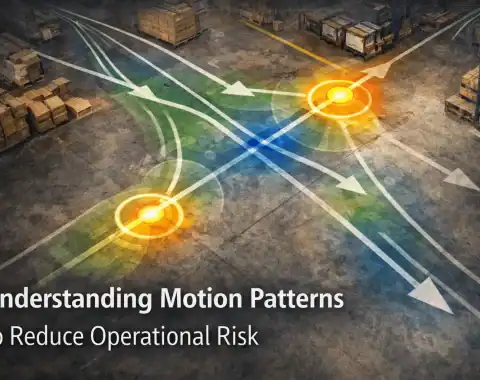
Behavioral and spatial analytics may uncover:
- Repeated congestion cycles
- Inefficient traffic routes
- Layout-related exposure
- High-risk intersections
- Operational bottlenecks linked to scheduling or workflow design
These insights support improvements in areas such as:
- Facility layout optimization
- Workflow redesign
- Traffic separation planning
- Safety training refinement
- Staffing and scheduling adjustments
Preparing Facilities for Scalable Industrial Growth
Industrial environments are evolving rapidly as automation, robotics, and smart infrastructure become more common. Modern facilities are becoming complex ecosystems where human workers, manual vehicles, and automated systems operate in constant interaction.
3D Vision AI solutions provide the adaptability needed in these changing environments. With centralized operational awareness, organizations can scale operations without losing visibility into emerging risks.
This supports:
- Mixed-fleet coordination
- Safer automation deployment
- Consistent operational oversight
- Adaptive safety strategies
- Scalable infrastructure intelligence
Final Thought
Industrial safety can no longer rely only on physical barriers, static rules, and isolated monitoring systems. Modern facilities require continuous operational awareness that can understand how movement, congestion, and interactions evolve throughout the day.
Learn how Cognistic’s iMANTRAX Solution, powered by Mantis IX overhead 3D Vision AI analytics, helps facilities strengthen centralized safety monitoring and real-time operational awareness.
Cognistic turns environmental activity into actionable intelligence, enabling industrial facilities to build more coordinated, scalable, and resilient operations.
Frequently Asked Questions
- In industrial settings, what are the applications of 3D Vision AI solutions?
3D Vision AI solutions analyze movement, depth, speed, and spatial interactions to improve operational awareness, identify unsafe conditions, and reinforce industrial safety.
- How does centralized safety monitoring improve industrial safety operations?
Centralized safety monitoring brings live alerts, analytics, and facility-wide visibility into one platform, enabling faster response and more consistent safety management.
- Is it possible to detect unsafe interactions in real time using Vision AI?
Yes. Vision AI continuously monitors industrial spaces and can automatically alert teams when unsafe proximity, restricted-area entry, congestion, or abnormal movement is detected.
- Are significant infrastructure changes needed for centralized monitoring?
No. Vision AI systems can often integrate with existing camera infrastructure, allowing organizations to improve monitoring without major disruption to daily operations.
- How do Vision AI analytics support long-term facility improvement?
Continuous behavioral analytics and movement intelligence help organizations refine layouts, workflows, training programs, scheduling, and operational efficiency over time.