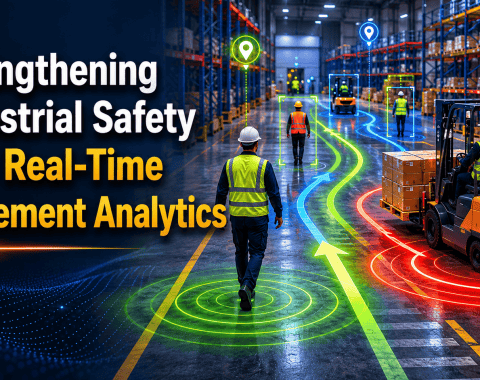
Industrial environments are becoming more connected, automated, and dynamic. Warehouses, factories, logistics centers, ports, and other operational sites bring people, vehicles, equipment, and automated systems together in environments where conditions can change in seconds.
That creates a fundamental challenge: how can an organization understand what is happening in its physical environment quickly enough to make better decisions?
This is where Industrial Vision AI comes into play.
Industrial Vision AI combines computer vision, sensing technologies, and artificial intelligence to help systems detect and understand people, objects, movement, and spatial relationships. Instead of simply capturing images, the goal is to turn visual information into contextualized intelligence that can support safety, automation, and operational decisions.
What is Industrial Vision AI?
Industrial Vision AI refers to the use of artificial intelligence and computer vision in real-world industrial environments. A camera or sensor provides information about the environment, while AI models process that information to identify relevant objects, movements and events.
The important distinction is between seeing and understanding. A conventional camera records a scene. A Vision AI system can interpret selected elements of that scene and provide information that software or equipment can use.
Why spatial awareness matters
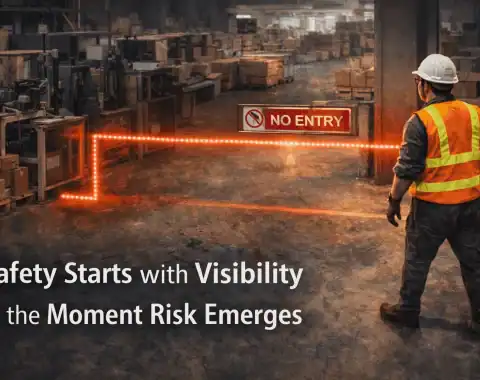
Industrial safety and automation often depend on more than recognizing an object. The system may also need to understand distance, position, direction and proximity.
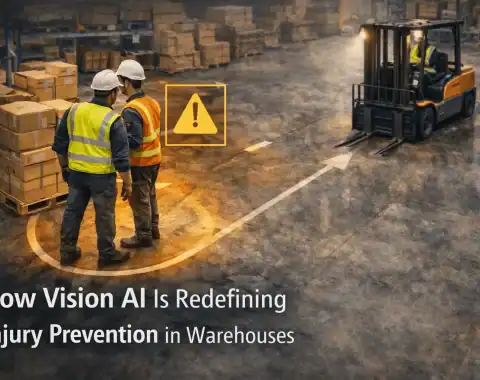
Consider a forklift operating near pedestrians. Identifying a person is useful, but knowing that the person is entering a defined risk zone around a moving vehicle provides much more actionable context.
This is why 3D sensing and spatial awareness can be important in industrial Vision AI applications.
2D and 3D sensing can work together
Different industrial applications require different sensing approaches. 2D cameras can provide rich visual information, while 3D sensing can add depth and spatial information.
Combining these sources can help an AI system build a more contextual view of the environment. Cognistic describes its approach as harmonizing GPU-powered Vision AI with advanced 2D and 3D vision-based sensing to create spatial awareness for industrial applications.
Where Industrial Vision AI can be applied
- Industrial and warehouse safety
- Forklift and material-handling vehicle collision avoidance
- Pedestrian and obstacle detection
- Facility-wide movement and risk analysis
- Manufacturing and industrial automation
- Transportation and logistics environments
- Operational monitoring and analytics
From detection to action
The value of Vision AI is not limited to detection. In a real industrial application, information may need to trigger an alert, support an operator, feed an analytics platform or contribute to an automated response.
Cognistic’s Mantis IV is designed for on-vehicle collision avoidance. It uses advanced 3D imaging and AI to detect pedestrians, workers and obstacles in real time, with visual and audible alerts and an optional automatic-braking capability.
At a facility level, Cognistic’s Mantis IX is designed as an infrastructure-based approach that analyzes movement and collision risk across an environment.
Why edge processing matters
Industrial applications can have strict latency, connectivity and reliability requirements. Processing data at or close to the point where it is generated can reduce dependence on continuous cloud connectivity and support fast responses.
Cognistic uses NVIDIA edge-based computing technology in its Vision AI ecosystem and works with sensing and depth-technology partners.
What organizations should consider
- Define the operational problem first.
- Identify the people, vehicles, objects and interactions the system needs to understand.
- Consider lighting, weather, dust, occlusion, traffic patterns and mounting conditions.
- Determine where processing should occur and what connectivity is required.
- Define what happens when a risk is detected.
- Plan for analytics and continuous improvement where relevant data can provide additional insight.
As industrial environments become more automated, the ability to understand physical space becomes increasingly important. Vision AI can provide a bridge between digital intelligence and the physical world.
Talk to Cognistic about your Vision AI application.