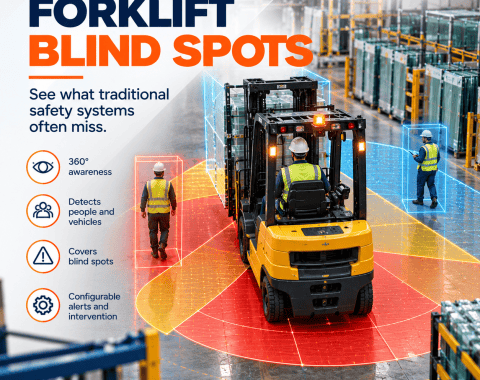
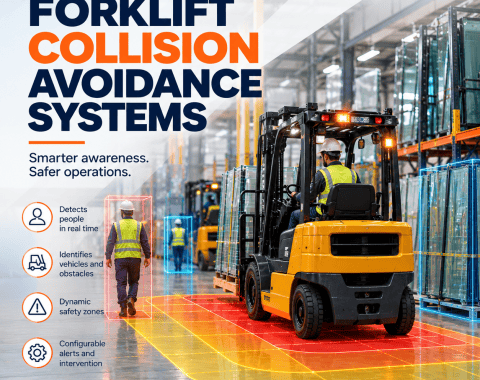
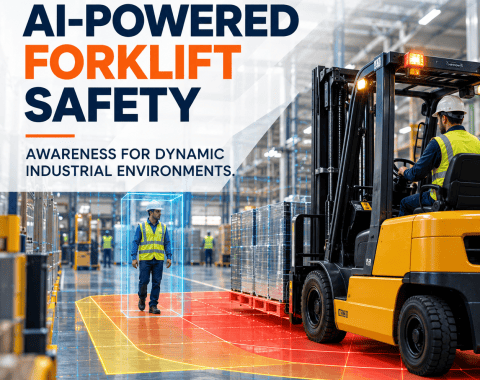
Pedestrians and forklifts often work in proximity, even at sites with defined routes and safety procedures. A worker can enter an aisle while carrying materials, a driver can approach a blind corner, and a load can obstruct the operator’s line of sight. These situations make pedestrian awareness an important part of material-handling safety.
AI-powered pedestrian detection uses computer vision to identify people in camera images or other sensor inputs. When combined with spatial sensing and appropriate risk logic, it can help determine where a person is relative to an industrial vehicle and whether the interaction may require an alert. This is a practical application of Vision AI: turning visual information into operational context.
Step 1: capture the environment
Cameras or sensors monitor a defined area around the forklift. Their placement, field of view, and the vehicle configuration matter. No system can reasonably be expected to see through opaque loads or physical barriers, so the detection design and operating procedures must account for blind zones and occlusion.
Step 2: identify people
A computer vision model analyzes the incoming data to recognize relevant human features. The system can then label the object as a person rather than merely detecting that something is present. Recognition performance can vary with lighting, posture, clothing, visibility, and other environmental conditions.
Step 3: add spatial awareness
Where supported, 3D vision or depth sensing adds information about the person’s location and proximity. This allows a system to distinguish, for example, someone standing farther from an operating path from someone entering a configured warning zone. Depending on the product, direction and movement can also be considered as part of risk assessment.
Step 4: communicate a response
When a defined risk condition is detected, the system can provide visual or audible feedback to the operator. Some configurations may support an additional integration or intervention, but those functions must be verified against specific vehicle and product requirements. Driver awareness and safe operating procedures remain essential even with automated assistance.
What does this mean for warehouse teams?
Pedestrian detection is most valuable when designed around a clear operational question: Where are the interactions, and what action should happen when they become risky? Site teams should test representative situations such as aisle crossings, approaching people, partial occlusion and changing traffic density. They should also train personnel on system limits and response procedures.
Cognistic’s Mantis IV is positioned around industrial vehicle collision avoidance using AI and 3D vision. Organizations considering the technology should assess which pedestrian scenarios need coverage and how the system would integrate with existing controls.
A safer facility depends on people, process, and technology working together. AI pedestrian detection can add meaningful awareness, but it must be deployed and tested as part of that complete system.
Explore pedestrian detection with Cognistic: https://cognistic.ai/mantis-iv/