Introduction
Industrial warehouses are defined by constant movement. Forklifts, pallet jacks, automated transport systems, and pedestrians operate simultaneously within shared spaces. As organizations pursue higher efficiency and automation, safety risks increase—particularly in environments where visibility is limited and operating conditions are harsh.
To maintain safe operations on a scale, warehouses require collision avoidance systems that are not only intelligent but engineered for real-world industrial conditions. This is where Mantis IV, Cognistic’s vehicle-mounted collision avoidance system, plays a critical role—delivering reliable detection and intervention even under dust, vibration, poor lighting, and continuous operational stress.
Why Ruggedized Collision Avoidance Matters in Real Operations
Safety technologies that perform well in controlled environments often struggle in real warehouses. Dust accumulation, vibration, temperature fluctuations, and inconsistent lighting degrade sensor performance and compromise reliability.
Mantis IV is designed specifically for these conditions
It combines industrial-grade hardware with adaptive Vision AI algorithms capable of maintaining accurate perception even when environmental signals are degraded. By operating directly on the vehicle and at the edge, Mantis IV delivers consistent situational awareness without relying on fragile assumptions or ideal conditions.
This robustness is essential for safety-critical decision-making in environments where false negatives—or false positives—carry operational cost.
Preventing Incidents Before They Escalate
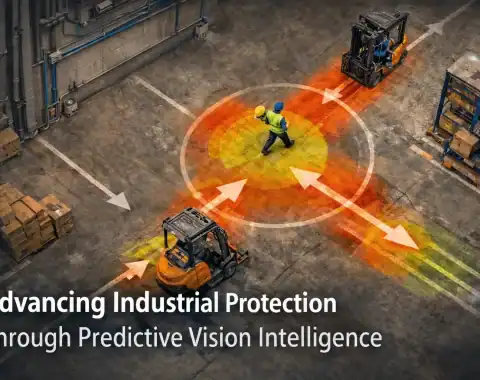
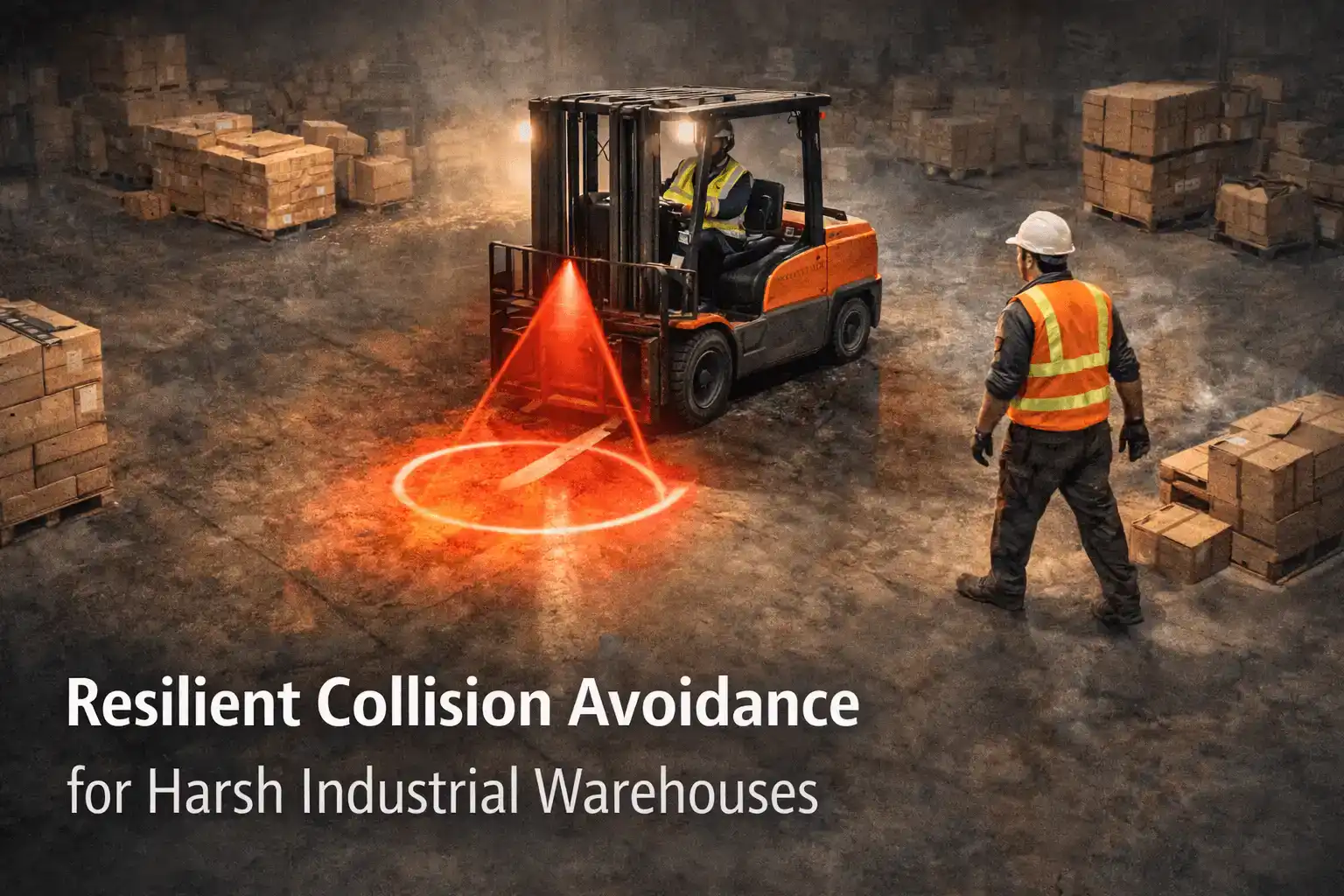
Effective collision avoidance begins with accurate perception and ends with timely intervention. Mantis IV continuously analyzes the vehicle’s surroundings, detecting pedestrians, obstacles, and other vehicles in real time. It evaluates relative speed, distance, and trajectory to assess collision risk as situations evolve.
When risk thresholds are exceeded, Mantis IV initiates a graduated response:
Early-stage visual and audible warnings alert the operator.
If risk persists, automated intervention can slow or stop the vehicle.
This operator-in-the-loop approach ensures safety without removing human control, allowing operators to respond while the system provides a critical safeguard against late reactions or blind spots.
Designed for Harsh, Low-Visibility Environments
Warehouses often present conditions where conventional cameras struggled with clouds, shadows, glare, and cluttered backgrounds. Mantis IV is engineered to perform reliably in these environments, maintaining detection accuracy where traditional systems fail.
This reliability directly reduces near-miss events and collision-related downtime. For organizations pursuing zero-incident strategies, dependable performance under adverse conditions is not optional.
Scaling Safety Across Fleets
Long-term safety improvement requires more than a single retrofit. Mantis IV is designed to scale across mixed fleets and vehicle types with minimal disruption. The system can be deployed consistently across forklifts and industrial vehicles without major mechanical modification.
Optional fleet-level insights allow organizations to:
- Monitor system health.
- Compare risk exposure across vehicles and shifts.
- Identify patterns that inform layout changes or operator training.
This systems-based approach enables a shift from reactive incident management to proactive risk reduction on a scale.
Supporting Zero-Incident Strategies
Achieving zero incidents is a strategic objective that requires alignment between technology, process, and human factors. Mantis IV contributes by reducing both the frequency and severity of collision events, while generating data that supports continuous improvement.
By analyzing near-miss events and contextual risk patterns, teams can:
- Adjust traffic rules and vehicle routes.
- Improve operator scheduling during high-risk periods.
- Refine facility layouts to reduce blind zones.
These incremental, data-driven improvements compound over time—lowering overall exposure and strengthening operational resilience.
Operational Value Beyond Safety
Investing in resilient collision avoidance delivers benefits beyond accident prevention. Reduced collisions mean:
- Less equipment and product damage
- Lower downtime and maintenance costs
- Improved operator confidence and morale
When operators trust that safety systems are reliable, productivity improves and turnover decreases. Additionally, the insights generated by Mantis IV support better decisions around routing, throughput, and resource allocation.
Final Thought
Safety in industrial warehouses is an engineering challenge that must be solved under real-world conditions. Mantis IV delivers rugged, vehicle-mounted collision avoidance designed for harsh environments, enabling organizations to scale operations without compromising safety.
By combining real-time detection, graduated intervention, and deployment-ready design, Cognistic supports warehouses in building safer, more reliable operations—aligned with long-term efficiency and zero-incident objectives.
Frequently Asked Questions (FAQs)
- What makes Mantis IV suitable for harsh industrial environments?
Mantis IV uses industrial-grade hardware and adaptive Vision AI to operate reliably in dust, vibration, temperature variation, and poor lighting.
- How does Mantis IV reduce false stops or unnecessary intervention?
The system uses contextual risk assessment and graduated responses, distinguishing real collision threats from transient environmental noise.
- Can Mantis IV be installed on existing forklifts?
Yes. Mantis IV is designed for retrofit across a wide range of industrial vehicles with minimal downtime.
- Does Mantis IV support fleet-wide safety strategies?
Yes. While operating at the vehicle level, Mantis IV can support fleet-level analysis to identify recurring risk patterns and improvement opportunities.
- Is zero-incident operation realistic with collision avoidance systems?
While no system guarantees zero incidents, Mantis IV significantly reduces exposure and supports strategies aimed at achieving near-zero collision environments.