Introduction
Near-miss incidents are often the most overlooked safety signal in warehouse operations. While they rarely result in immediate harm, their frequency and location reveal where risk is quietly accumulating. In one regional distribution center, leadership recognized that relying on incident reports and manual reviews provided an incomplete picture of daily exposure. They needed a way to observe safety conditions continuously, understand recurring behaviors, and intervene before close calls escalated into serious events.
The Challenge: Growing Activity, Limited Awareness
Several structural factors contributed to rising exposure:
- Narrow aisles with limited maneuvering space
- Intersections shared by pedestrians and forklifts
- Blind corners with obstructed visibility
Temporary staff unfamiliar with site layout and traffic rules
Existing cameras provided footage but little intelligence. Supervisors could review recordings, but the system offered no guidance, no alerts, and no insight into recurring unsafe patterns.
Near-miss events were increasing not because of isolated mistakes, but due to latent structural risk embedded in daily operations.
The Decision: Deploying Centralized Vision AI Safety Intelligence
After evaluating multiple vendors, the facility selected Cognistic’s iMANTRAX Solution, supported by overhead Vision AI analytics (Mantis IX), to deliver centralized, predictive safety intelligence across the site.
Rather than deploying disconnected tools, the organization implemented a single, integrated platform providing:
- Overhead monitoring of shared human–machine zones
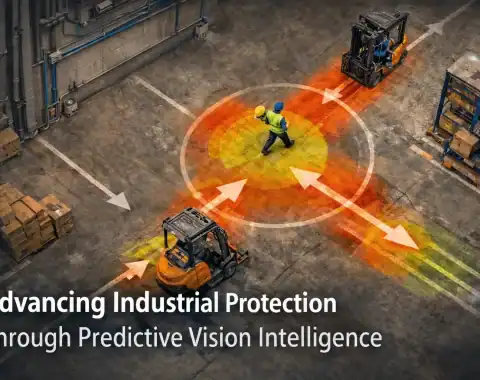
- Real-time detection of unsafe pedestrian and vehicle interactions
- Restricted-zone awareness and perimeter monitoring
- Centralized dashboards for alerts, live views, and analytics
- Behavioral risk and compliance analytics across shifts and zones
- The objective was not surveillance, but continuous, facility-level awareness.
What the First Weeks Revealed
Within the first month of deployment, the system uncovered previously unquantified risks:
Unintended pedestrian crossings
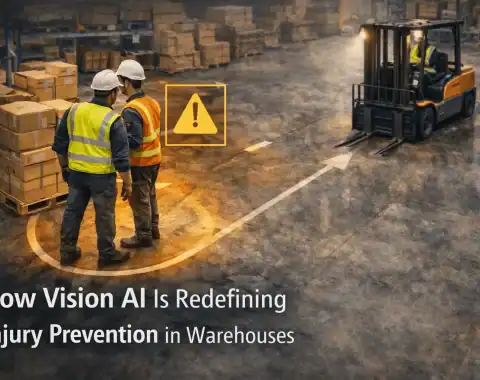
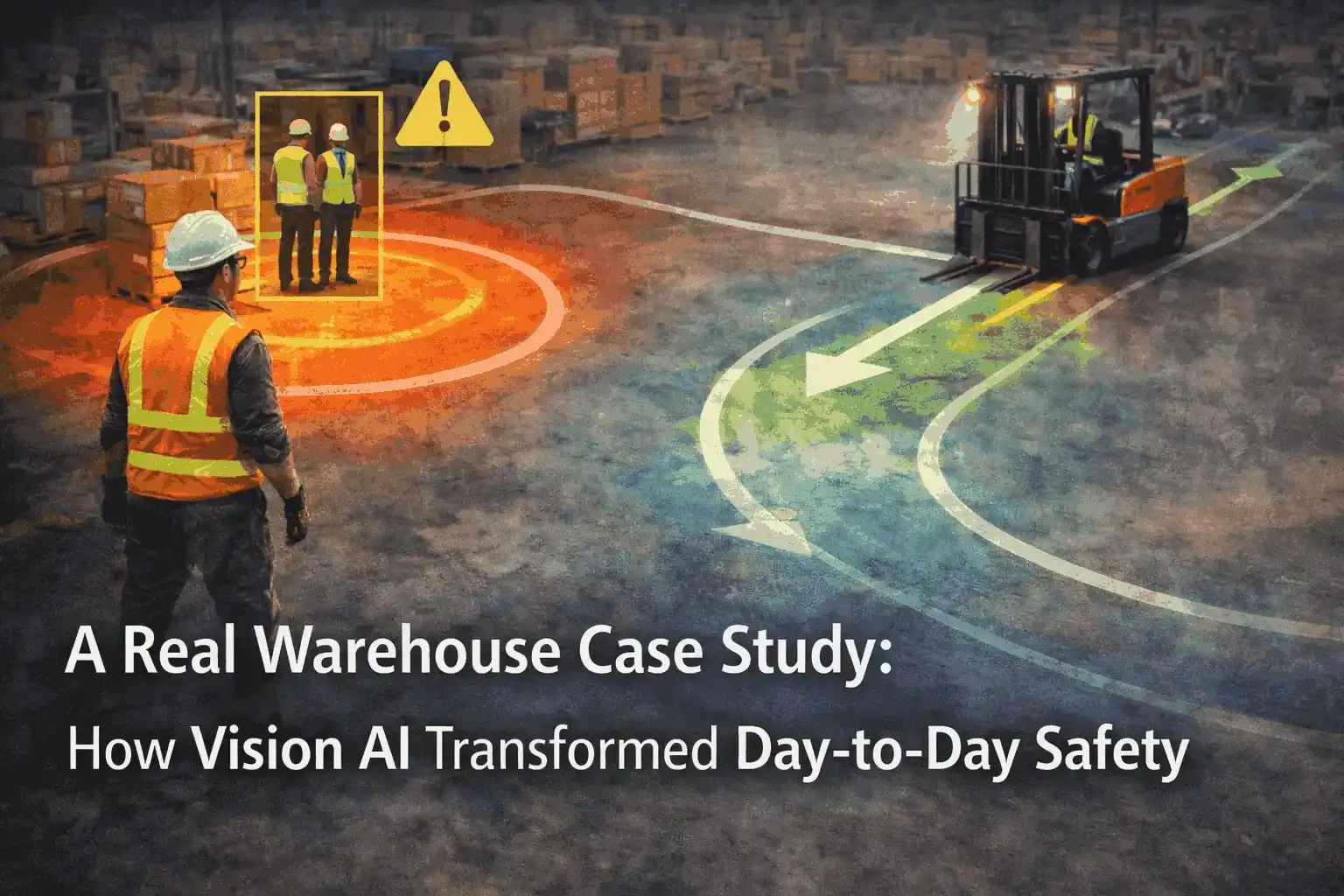
Workers frequently crossed forklift lanes without realizing the level of exposure. Overhead Vision AI detected these interactions in real time, triggering immediate alerts that prevented incidents.
Inefficient vehicle movement patterns
Forklift trajectories revealed consistently wide turns caused by pallet placement and aisle design. Analytics provided objective evidence, enabling supervisors to redesign spacing and reduce risk.
Predictable congestion cycles
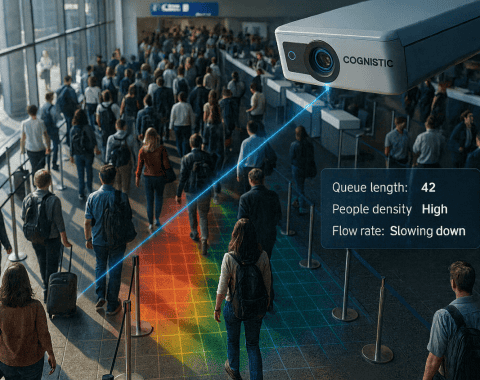
Congestion near loading docks spiked during shift changes. Behavioral analytics linked these patterns to scheduling practices, not individual behavior.
For the first time, supervisors had measurable evidence of risks they had long suspected but could not prove.
From Insight to Action
Armed with data, the facility implemented targeted, evidence-based changes:
- Pedestrian walkways were clearly defined and enforced
- Aisle layouts were adjusted to reduce tight turning zones
- Shift schedules were optimized based on congestion analytics
- Restricted areas were equipped with automated zone alerts
Crucially, the system did more than record incidents. When a worker entered a restricted or high-risk zone, real-time alerts were issued immediately—to the individual and to supervisors via the centralized dashboard.
Over time, behavioral risk analytics highlighted recurring unsafe practices, enabling focused training and policy refinement rather than broad, reactive measures.
Building a Safer Culture Through Transparency
Initial skepticism gave way to trust. Workers recognized that the system was designed to prevent harm, not monitor individuals. Audible and visual alerts helped them avoid danger, particularly in blind spots. Forklift operators valued the added layer of situational awareness.
Supervisors benefited from a unified, real-time view of safety across the facility. Decisions were faster, more confident, and based on evidence rather than assumption.
Within three months, near-miss incidents declined significantly. Safety improvements also translated into smoother operations, fewer interruptions, and improved productivity.
Final Thought
This case demonstrates how warehouse safety can evolve from reactive checklists to predictive, data-driven intelligence. By combining centralized monitoring, overhead Vision AI, and behavioral analytics, the facility transformed safety into a continuous operational capability.
Through platforms like iMANTRAX Solution, Cognistic enables organizations to identify risk earlier, act decisively, and build safer, more resilient industrial environments—by design.
Frequently Asked Questions (FAQs)
- How does iMANTRAX Solution support centralized safety monitoring in warehouses?
iMANTRAX Solution provides a single, centralized interface that consolidates real-time alerts, live Vision AI views, and historical analytics. This enables supervisors to respond faster, understand risk patterns clearly, and manage safety consistently across the facility.
- Why is behavioral risk analytics important, and how does Cognistic deliver it?
Behavioral risk analytics identify repeated unsafe patterns that may not lead to immediate incidents but increase long-term exposure. iMANTRAX Solution detects these patterns and helps teams refine training, policies, and facility design proactively.
- Can Mantis IX reduce pedestrian-related risk in warehouses?
Yes. Mantis IX uses overhead 3D Vision AI to detect unsafe interactions between pedestrians and vehicles at shared zones and intersections. It issues real-time alerts when risk thresholds are exceeded, helping prevent near-miss events before they escalate.
- Do Cognistic Vision AI systems work in high-activity, cluttered environments?
Yes. Mantis IX and iMANTRAX Solution are designed specifically for busy, dynamic industrial settings with high traffic density, variable lighting, and frequent operational changes. The systems maintain accuracy even in complex, high-throughput environments.
- Does deploying iMANTRAX Solution or Mantis IX require extensive training?
No. Both iMANTRAX Solution and Mantis IX are designed for rapid adoption. The systems operate autonomously and require only minimal onboarding for operators and supervisors, allowing teams to focus on operations rather than system management.