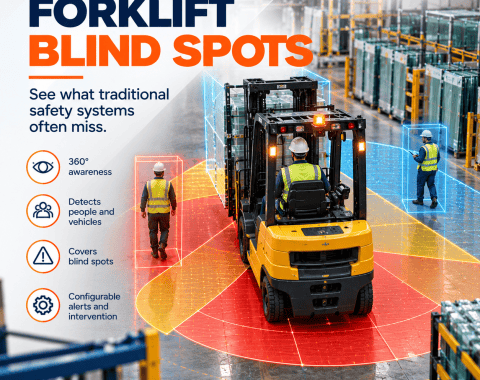
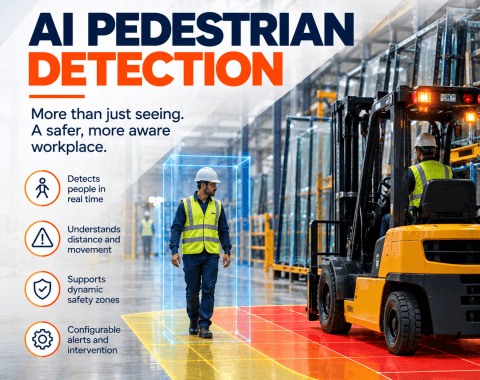
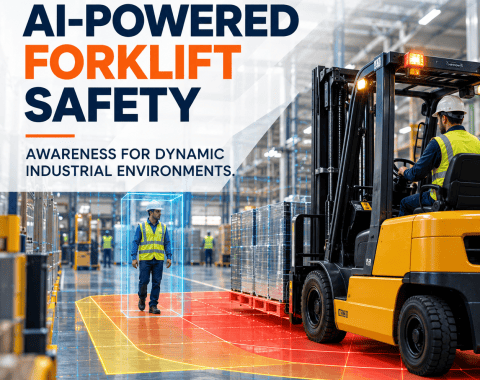
A forklift collision avoidance system is a technology designed to help identify potentially hazardous interactions between an industrial vehicle and people, obstacles, or other assets. Depending on the product, the system may alert the operator, provide situational information, or integrate with vehicle functions to support a configured response. These technologies are most useful when selected to address the actual risks of a site.
Why are collision avoidance systems needed?
Warehouses and industrial facilities often bring mobile equipment into shared spaces with pedestrian walkways, racks, machinery and loading operations. Even with traffic rules and trained operators, visibility can be restricted by tall loads, shelving, aisle corners, and the vehicle itself. A collision avoidance system can provide an additional source of information, especially when a person or object is difficult for the operator to see.
What types of technology are used?
Different systems may use cameras, radar, ultrasonic sensing, tags, lasers, or combinations of these technologies. Some are configured to warn when a detected object enters a defined zone. Vision AI systems use image processing to identify categories such as people or vehicles. Systems equipped with 3D sensing may also estimate depth or spatial position. No single technology is ideal for every facility; environmental conditions and detection requirements matter.
How is detection different from collision-risk assessment?
Detection answers whether the system recognizes a person or obstacle. Risk assessment asks whether the person or obstacle is relevant to the vehicle’s current operating situation. Distance, direction, speed, and an object’s relationship to the vehicle path can all influence that assessment, subject to what a particular product supports. Buyers should request a demonstration of the actual warning logic rather than assuming every marketed “AI” capability works in the same way.
What should a procurement team ask?
Ask what the system detects; how it handles occlusion and unusual obstacles; how far and in which directions it senses; whether zones can be configured; how alerts are presented to drivers; and whether any vehicle-control integration is supported and validated. You should also consider installation effort, compatibility with the fleet, maintenance, operator training, and the method used to verify operation after deployment.
How does it integrate into the safety program?
Technology should reinforce—not replace—a broader system of controls. Dedicated pedestrian routes, clear signage, safe speeds, traffic management, maintenance and operator training remain essential. A collision avoidance system may help highlight conditions that warrant attention, but teams still need practical procedures for responding to alerts and reviewing recurrent issues.
Where Cognistic fits
Cognistic’s Mantis IV provides an AI-enabled, vehicle-based approach to industrial collision avoidance. It is relevant to operations seeking computer-vision and 3D spatial-awareness capabilities around material-handling vehicles. The appropriate configuration depends on the vehicle, the application, and validated performance in the deployment environment.
For an effective evaluation, start with your most challenging vehicle-pedestrian or vehicle-obstacle interaction. Then ask for a scenario-based demonstration that reflects how your site actually operates.
Explore Mantis IV and discuss your forklift collision-avoidance requirements: