
Introduction
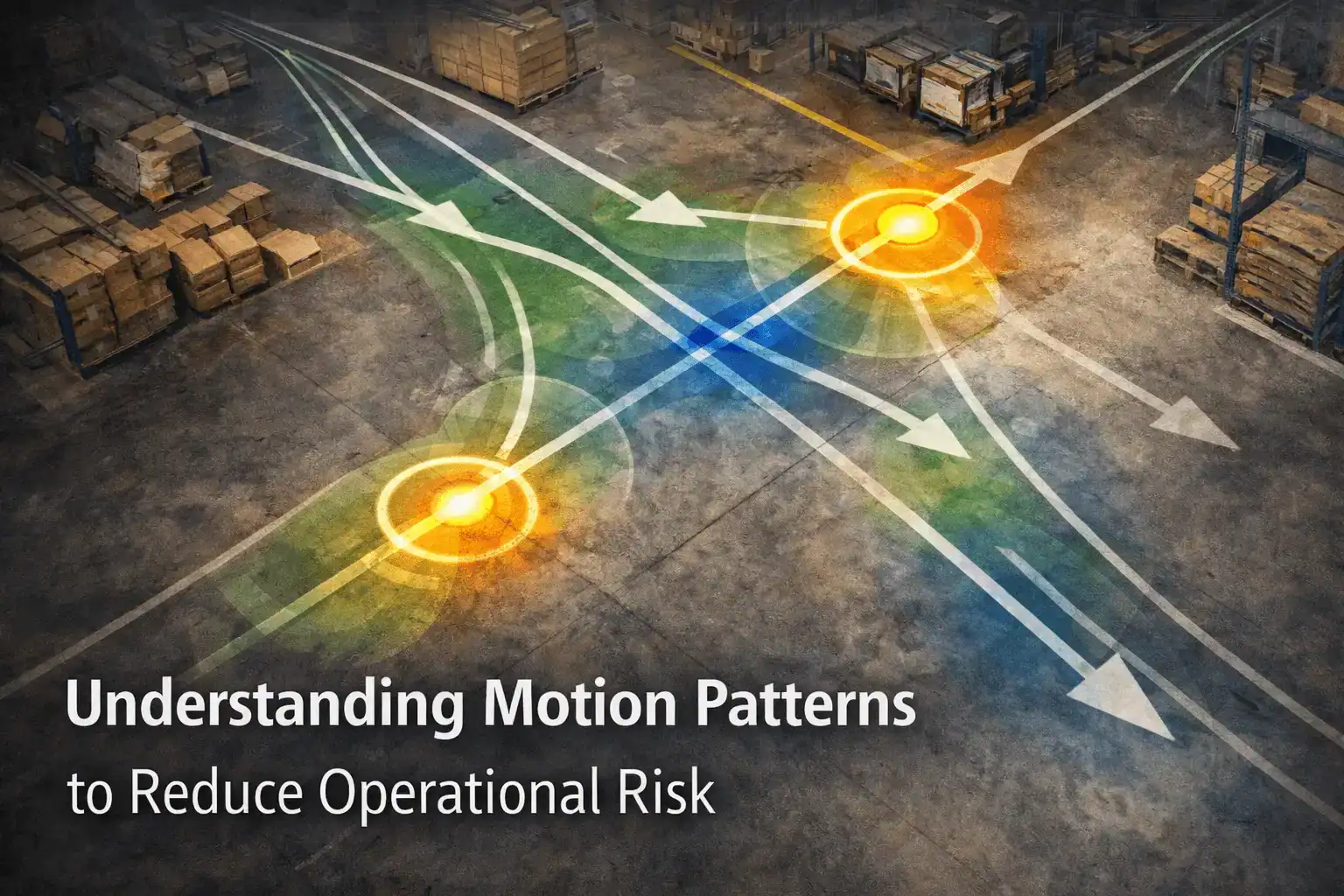
Operational risk in warehouses is rarely random. It is shaped by how movement repeats itself over time where vehicles slow down, where pedestrians cross, and where congestion becomes routine. Yet many facilities still assess safety based on isolated observations rather than continuous analysis. By examining motion as structured data instead of background activity, organizations can uncover patterns that explain why certain areas become risky and how those risks can be reduced before incidents occur.
Why Understanding Movement Matters for Safety
Movement inside a warehouse is rarely random. Forklifts follow predictable routes, operators adhere to routines, and pedestrian traffic concentrates around specific times and locations. Safety incidents often emerge not from isolated errors, but from subtle changes in speed, direction, proximity, or density.
Mantis IX continuously analyzes motion at the zone level, capturing signals such as:
- Movement speed and direction
- Interaction frequency between pedestrians and vehicles
- Dwell time within shared spaces
- Congestion patterns at intersections and aisles
By converting these signals into structured insights, safety teams gain clarity on where risk accumulates and why certain areas become hazardous under specific conditions.
From Reactive Response to Predictive Safety Strategy
Traditional safety programs rely on incident investigation followed by corrective policy updates. In fast-paced environments, this approach leaves little room for prevention. Waiting for incidents to occur—even minor ones—means exposure has already materialized.
With predictive motion analytics, safety strategy shifts upstream. Mantis IX identifies conditions that precede incidents, enabling teams to intervene before risk escalates.
For example:
- Repeated congestion in a specific aisle during peak hours may indicate the need for route adjustments or task staggering
- Elevated turning speeds near blind corners may prompt speed controls or visual layout cues
- Frequent pedestrian crossings at shared zones may require redesign or controlled access
These data-driven interventions reduce risk proactively, without relying on enforcement or after-the-fact corrections.
Using Motion Insights to Strengthen Training and Awareness
Effective training is grounded in real operational behavior. Over time, habits and shortcuts develop—often unintentionally increasing exposure. Motion analytics provide objective evidence of these patterns, allowing training efforts to be targeted and relevant.
With insights from Mantis IX:
- Operators receive feedback based on observed behavior, not assumptions
- Supervisors tailor training to specific zones or recurring risk patterns
- High-risk intersections and routes are clearly visualized for awareness
- New employees are guided with evidence-based safety context
This approach improves understanding across teams, particularly during high-activity periods, without disrupting daily operations.
Continuous Monitoring in Dynamic Environments
Warehouse layouts, workflows, and demand levels evolve constantly. Motion patterns change with new equipment, seasonal volume increases, or process updates. Static safety rules quickly become outdated.
Mantis IX provides continuous, adaptive monitoring, ensuring safety insights remain aligned with real-world conditions. By analyzing live movement data over time, teams maintain an up-to-date view of risk as operations change supporting informed decisions throughout the year.
This continuous intelligence prevents organizations from being surprised by emerging risks tied to operational shifts.
Turning Everyday Movement into Preventive Insight
Rather than relying on intuition or isolated observations, Mantis IX transforms everyday movement into predictive safety intelligence. By understanding how people and machines interact across zones, warehouses gain a practical foundation for reducing incidents, improving layout design, and supporting safer workflows.
Watch how Cognistic’s Mantis IX turns motion data into actionable insights that help teams stay ahead of operational risk.
Final Thought
Safer warehouses begin with understanding how movement actually unfolds on the floor. When motion patterns are analyzed continuously and used to guide preventive action, safety becomes more precise, predictable, and effective.
Mantis IX enables this shift by providing overhead, zone-based Vision AI analytics that support proactive risk management. By replacing assumptions with data-driven insight, Cognistic helps organizations build safer, more resilient operations designed to evolve alongside their workflows.
Frequently Asked Questions (FAQs)
- Why is motion analytics important for warehouse safety?
Motion analytics reveal how speed, proximity, and congestion contribute to risk, allowing teams to address unsafe conditions before incidents occur.
- How does Mantis IX support safer workflows?
Mantis IX analyzes movement across shared zones, identifying high-risk patterns and providing insights that inform layout changes, training, and scheduling.
- Can motion analytics work with existing safety systems?
Yes. Mantis IX complements existing safety tools by adding predictive, data-driven insight without requiring major infrastructure changes.
- Does deploying Mantis IX require operational disruption?
No. The system integrates with existing camera infrastructure and operates overhead, minimizing impact on daily operations.
- Who benefits most from analytics-driven safety?
Operators, supervisors, and facility managers all benefit from clearer visibility, faster decision-making, and more effective risk prevention.